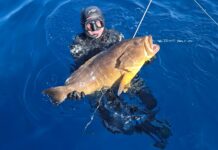

Interview with Dr. Maria Silvia Amaddii, FIPSAS Federal doctor, and what Valerio Losito’s Accident teaches us
It’s time to gain a better understanding of and reflect on safety in spearfishing competitions. The accident that befell Valerio Losito during the Italian Spearfishing Championship in Mazara del Vallo has deeply affected the entire community. Fortunately, after days of great concern, the champion from Puglia has shown a recovery that has pleasantly surprised everyone.

This incident therefore provides an important opportunity to reflect on safety in spearfishing competitions and on which tools are truly essential for further reducing risks.
We talked about it with Dr. Maria Silvia Amaddii , FIPSAS Federal Doctor.

Carlo Forni: Valerio Losito, after the accident in Mazara del Vallo, brought us immense joy with an almost miraculous recovery—and, apparently, without any permanent brain damage. How is such a recovery possible, given the blackout he experienced in the water and the time it took for help to arrive?
Dr. Maria Silvia Amaddii: Valerio experienced a temporary loss of consciousness without cardiac arrest. Rather than a classic syncope, it was a blackout accompanied by airway flooding and consequent marked hypoxemia—that is, a significant reduction in blood oxygenation—which inevitably leads to damage to particularly sensitive organs such as the brain.
The recovery observed is objectively extraordinary. Hospital treatment certainly played a decisive role, but I believe that certain specific adaptive mechanisms developed by freedivers who regularly dive to medium depths may also have contributed.
In fact, there are studies that have drawn inspiration from cetaceans and certain species of sea turtles—animals capable of producing proteins that protect the nervous system during prolonged periods of hypoxia. Some studies have investigated the presence of similar protective mechanisms in freedivers and spearfishers, highlighting physiological adaptations that could help limit neurological damage resulting from episodes of severe oxygen deprivation.
The same phenomenon is often observed in cases of taravana: once the acute phase has passed, many athletes fully recover their neurological functions even though an MRI or CT scan may reveal significant abnormalities. Similar injuries in people who are not trained in freediving could have much more serious neurological consequences.
Carlo Forni: The incident in Mazara shows that safety can and must be further improved. In your opinion, what are the truly essential pieces of equipment during a spearfishing competition?
Dr. Maria Silvia Amaddii: The most important factor is definitely the presence of a doctor. Personally, I believe that, depending on the number of athletes present and the size of the competition field, it is best to have an adequate number of doctors on hand.
It is not essential to have a resuscitation specialist. Instead, it is essential that the physician be familiar with the typical critical conditions associated with scuba diving and spearfishing: blackouts, decompression sickness, acute pulmonary edema, as well as, of course, the management of trauma, dehydration, and other emergencies that may occur during a competition.
Carlo Forni: There’s been a lot of talk in recent days about the requirement to have an oxygen cylinder on every boat. Is it really that important? Do you need a license to use it?
Dr. Maria Silvia Amaddii: Oxygen is the primary therapeutic intervention in major spearfishing emergencies. However, it is important to remember that oxygen is, in every respect, a drug and, if used improperly, can even be toxic.
In emergency situations, however, thenormobaric oxygen is the first line of treatment.
For portable cylinders—for example, those holding about three liters— no specific license is normally required for purchase or use. Training courses are certainly useful and recommended, but they are not an essential requirement for using normobaric oxygen during an emergency.
Hyperbaric oxygen therapy is a different matter altogether; it requires entirely different procedures and should not be confused with the simple administration of oxygen at the surface.
It should also be noted that, according to FIPSAS regulations, Oxygen may not be used before, during, or after a race to enhance athletic performance. Of course, this prohibition does not apply to its use in the event of an accident. , where it is, in fact, an essential first-aid tool.
Carlo Forni: How important is the time factor?
Dr. Maria Silvia Amaddii: The answer is simple: the doctor must get to the athlete immediately.
The speed of intervention is crucial for limiting damage and increasing the chances of a full recovery. For this reason, medical personnel should go directly to the competition venue to quickly reach the scene of the emergency.
Carlo Forni: What should be the minimum equipment required for a doctor on the competition field?
Dr. Maria Silvia Amaddii: The equipment consists of the basic kit already found in ambulances. Specifically, on the field , the doctor must have oxygen, which is the primary lifesaving device.
In addition to this, there are essential tools such as:
- Pulse oximeter;
- Suction device for clearing the airways of fluids, blood, or mucus;
- Scissors for quickly cutting the fur;
- Disposable mouth-opening screws.
- Possibly also:
- Stethoscope;
- Sphygmomanometer for measuring blood pressure;
- Although these last two are not normally used in first aid procedures.


On a rubber boat, the main objective is, in fact, to stabilize the athlete and transport him or her as quickly as possible to the permanent medical facility on shore. A defibrillator, for example, will be standard equipment on the ambulance on shore.


Carlo Forni: What qualifications should the doctor in charge of care have?
Dr. Maria Silvia Amaddii: Even before specializing, it is important for a doctor to be familiar with the typical issues associated with spearfishing.
They must be able to quickly make a diagnosis, identify the type of emergency, and ensure the athlete’s safety until they are transferred to appropriate medical facilities.
Carlo Forni: How should healthcare on the ground be organized?
Dr. Maria Silvia Amaddii: It is essential to have a permanent medical facility consisting ofan ambulance that is always available and is not used for other purposes.
There should be a doctor and nurses on board who are able to reassess vital signs, complete clinical stabilization, and, if necessary, contact the 118 emergency system to arrange for transfer to a hospital.
Carlo Forni: What planning should be done before the competition begins?
Dr. Maria Silvia Amaddii: The organization should notify local healthcare facilities in advance, providing the dates, times, and expected number of participating athletes.
It would also be advisable to check in advance whether an ambulance equipped with a CPAP (pressurized oxygen) system, which is particularly useful in the event of acute pulmonary edema.
Carlo Forni: Many people believe that the hyperbaric chamber is the solution to any diving accident. Is that really the case?
Dr. Maria Silvia Amaddii: No. The hyperbaric chamber is an extremely important tool, but it is not the solution for every spearfishing emergency.
In fact, it is not a specific treatment for a blackout or a taravana.
It is, however, essential in decompression sickness (DCS), a condition typically associated with scuba diving and not with spearfishing.
For this reason, it is important that hospital staff also correctly distinguish between the various conditions, avoiding the tendency to automatically equate a spearfishing accident with decompression sickness.
A Final Thought
Valerio Losito ’s recovery is wonderful news for the entire community, but it must also serve as an incentive to continue investing in safety at spearfishing competitions, so that similar incidents can be handled using increasingly effective and up-to-date protocols.
Please note that FIPSAS already has safety regulations for spearfishing competitions—which, of course, can always be improved—and it is the organizer’s responsibility to apply them correctly.