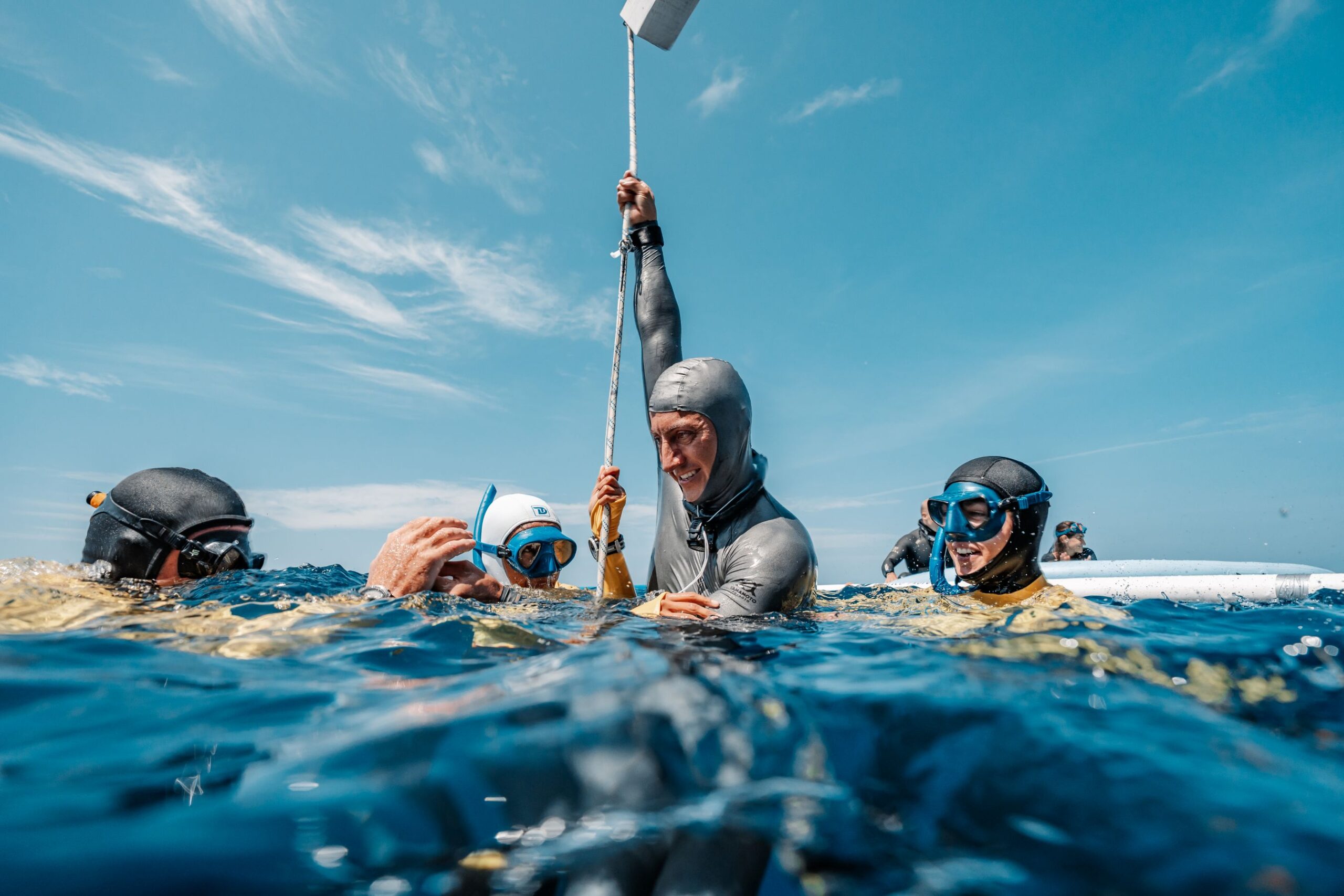
For Pedro Tapia, freediving is a journey of self-discovery in which each dive offers the opportunity to get to know himself better. Understanding the body’s sensations, observing his emotions, and recognizing when to push forward or rest are fundamental aspects of his growth as an athlete.
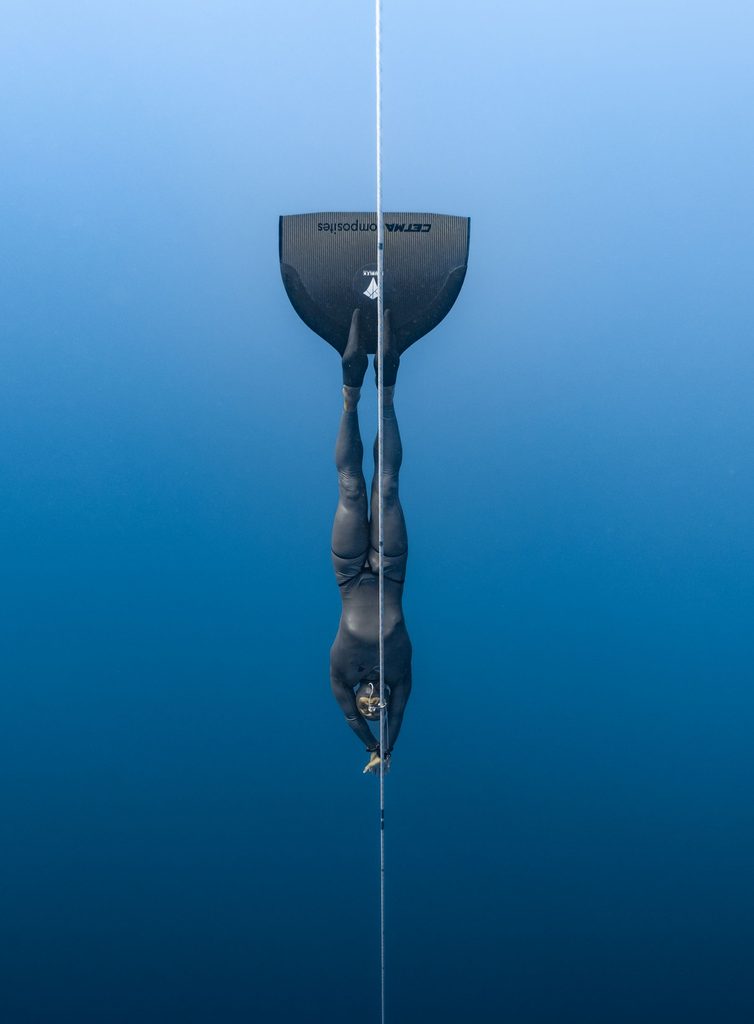
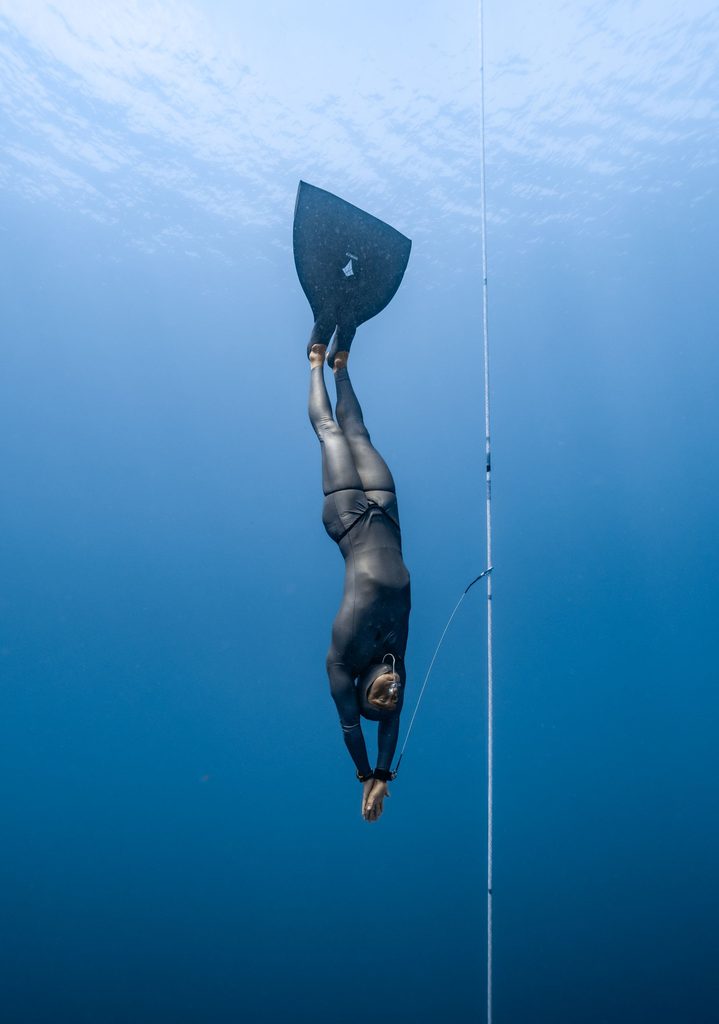
(Photo by Federico Buzzoni)
In this interview with Darina Chesheva, Tapia explains how he has developed his own training method, what he has learned from a largely self-taught career, and why medals and records have never been his main motivation. A conversation about physical and mental preparation, teaching, and the joy of diving.
Darina Chesheva: Pedro, to begin, could you take us back to the beginning of your journey? Tell us a little about your sport background, the experiences that first drew you to freediving, and what has kept you committed to it.
Pedro Tapia: Overall, I’ve always been a very active person and an athlete. As a child, I played soccer; as a teenager, I did a little gymnastics; and as an adult, I’ve always exercised or engaged in some form of physical activity. However, I had never participated in any sport at a competitive level until I took up freediving.
What has definitely kept me practicing it is the self-exploration and self-awareness I’ve developed over the years.
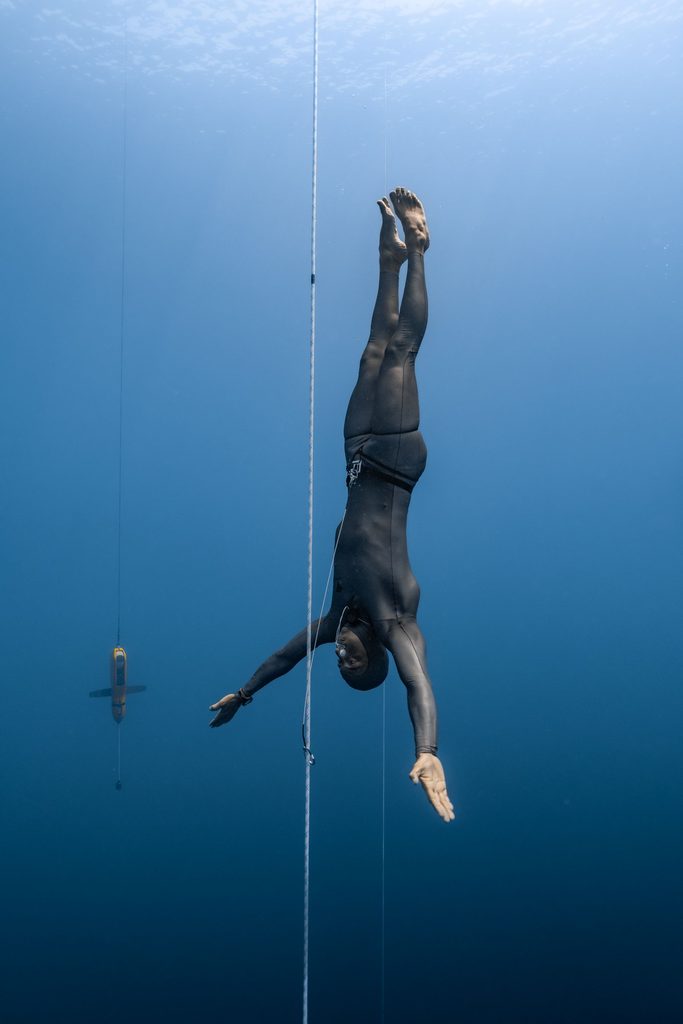
Darina Chesheva: You came to freediving relatively recently, yet in only a few years you have reached the world podium. What do you think allowed you to progress so quickly?
Pedro Tapia: I think there have been several factors. One of them has been committing to this athletic career, completely leaving behind what I was doing before, and dedicating myself full-time to both my personal and athletic development and my work as an educator. Another factor has been paying attention to all the small details of training, physical conditioning, rest, and nutrition. Many times, I’ve made great strides by making small changes.
Darina Chesheva: You are essentially self-taught and have learned a great deal through experimentation, experience and online resources. What were the advantages—and the dangers—of learning without a traditional coach?
Pedro Tapia: One of the most valuable things I’ve learned—largely on my own—has been how to observe myself. Self-observation is something I practice every day: observing my physical state, understanding my body and its sensations, recognizing when it’s time to push myself harder and increase the intensity, and also when it’s time to rest or take a break from training. Mental and emotional self-reflection has also been very important.
As individuals, we all process information differently, based on our beliefs and experiences. Something that has worked very well for me when making decisions is to visualize all possible scenarios—not just the one I want—and to be at peace with any of them as the outcome.
On the other hand, when it came to more technical aspects, I relied heavily on information from the internet, instructional videos, and YouTube tutorials at first. Once I started competing, I watched other athletes who inspired me to see what they were doing, learn about their routines, and even ask them for advice.
As for risks, I think one of the biggest ones for me has been wanting to control too many things: my training, my rest, my diet, my preparation, and even trying to anticipate how to handle situations that haven’t even happened yet.
Sometimes that can be mentally exhausting. But at the same time, that process has also helped me get to know myself much better.
Darina Chesheva: When something in your training or performance is not working, how do you decide whether to push through the problem or stop and rethink your entire approach?
Pedro Tapia: Naturally, I have a certain limit when it comes to patience and tolerance. If I stay within that limit, I can stick to the plan and understand that it’s part of the process.
However, when I feel like I’ve already crossed that threshold, my creativity kicks into high gear, and I start coming up with a Plan B or a Plan C. That way, I remind myself that there are always other paths to chart and explore.
Darina Chesheva: You have mentioned you do not consider yourself as competitive and work on your full potential without thinking what others do. Is it difficult to maintain that mindset when medals, rankings and other athletes’ performances are constantly visible around you?
Pedro Tapia: When I think about other athletes, I do so with admiration and inspiration. Every athlete has their own story and is running their own race.
Of course, I have competitive and comparative thoughts, because I’m a human being like everyone else, with a balance between humility and pride.
When I say I’m not a competitive person, what I mean is that I choose the mindset from which I make my decisions.
If my decisions stem from a desire for personal growth and confidence in what I know I can do, then they are consistent with my own process.
If I feel that a decision might stem from pride, from wanting to prove something, or even from comparing myself to someone else, I acknowledge that thought and understand that it’s part of that balance. I simply don’t act on it: I let it go and rethink the decision.
Darina Chesheva: What does a typical training week look like for you—and how much of that schedule is structured in advance versus adjusted according to how you feel?
Pedro Tapia: My basic training routine begins with a day of work—that is, a coaching session or working as an instructor. This keeps me diving at depths between 20 and 40 meters on a regular basis.
If possible, I go for a dive or do some technical exercises on my own, as long as the people I’m with can act as safety divers.
Next up is a gym session. I have a variety of workouts ranging from strength training with near-maximum weights to cardio and calisthenics sessions, as well as exercises I learned in gymnastics that are ideal for building strength, coordination, and proprioception.
Deep-dive training during the season is relatively easier. I start making progress that’s accompanied by a good feeling, solid buoyancy control, and, above all, the enjoyment of the dive.
If those three factors are present, I go deeper on the next dive and continue that way.
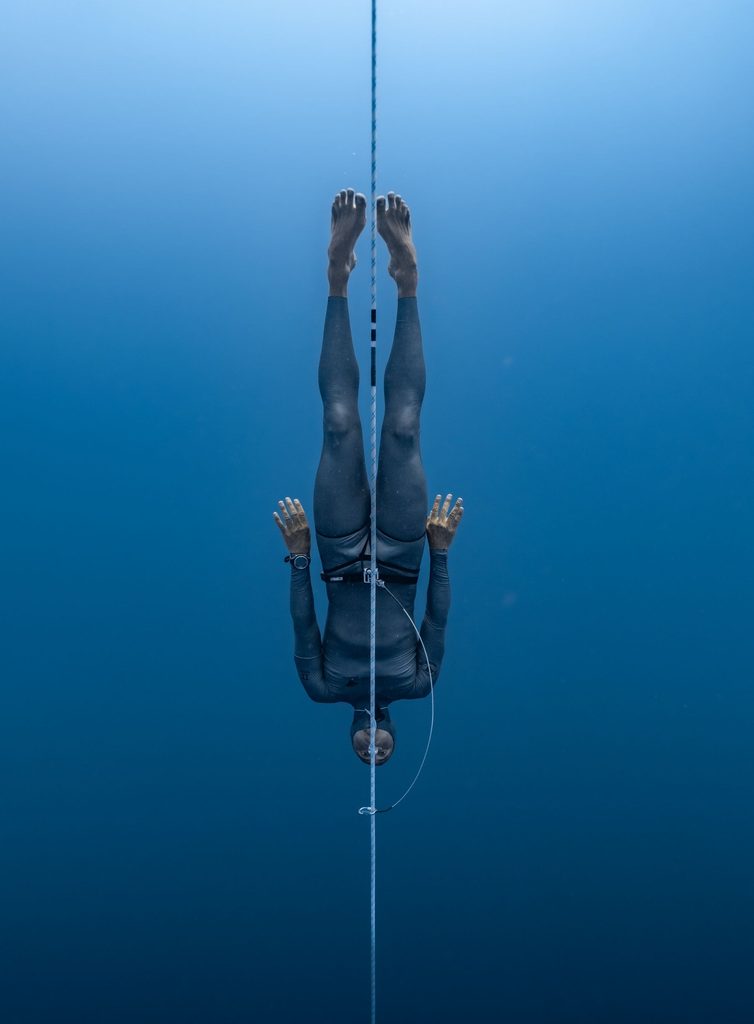
Darina Chesheva: Your training combines gymnastics and strength work, pool training and deep diving. How do these different environments complement one another?
Pedro Tapia: Gymnastics exercises have been key for me. They are full-body exercises that require developing a comprehensive awareness of the body: understanding muscle activation and inhibition, muscle chains, the body’s position in space, and coordination.
In the pool, I can really work on my technique and, above all, understand and feel how to move through the water. It’s a sensory experience that’s very important to develop.
The gym is where I can build the strength and endurance needed to prepare and adapt my body for different activities.
And, for me, depth is where I reap the rewards of everything that came before. My body is already ready, and it’s time to let go, relax, and enjoy myself.
Darina Chesheva: You won silver medals in both CWT and CNF at the CMAS World Championship in Honduras. Is there a discipline you particularly prefer? And, more broadly, do you feel more drawn to diving with fins or a monofin, or without it?
Pedro Tapia: I enjoy all four deep-diving disciplines, but constant-weight diving with a monofin (CWT) and constant-weight diving without fins (CNF) are, without a doubt, my favorites.
I don’t have a preference between these two. I think they’re complete opposites, and that’s exactly what I like about them.
Darina Chesheva: You are not only an athlete; you also work as a freediving coach. How has teaching other people changed your understanding of your own diving?
Pedro Tapia: Teaching and passing on knowledge to others is a way for me to constantly remind myself of my philosophy and my style. My students are a reflection of my own coaching.
What’s more, every student has something important to teach me. It might be something related to freediving, personality, resilience, or life in general.
I feel very fortunate to be able to practice this profession, because of the way it allows me to connect with people of all ages and from all over the world—people I might never have met if it weren’t for freediving.
Darina Chesheva: If freediving stopped giving you medals, records and recognition tomorrow, what would still make you go into the water?
Pedro Tapia: The records, medals, and athletic honors have been the result of the entire process. Of course, it’s nice and rewarding to receive them, but They have never been the main goal. And that’s a conversation I have with myself all the time, so I don’t fall into the trap of focusing solely on the result and the applause.
I’m going to keep enjoying the water and diving, regardless of any awards. And, by the way, it’s something that’s bound to happen. Someone stronger, younger, and better will come along. That’s just how it is in sports. If, along the way, I can inspire others to make that happen, all the better!
When I talk to my students about how and where to place their achievements, I always tell them: Your family, your friends, and the people closest to you will surely be happy if you achieve your goals. But they don’t love you for your achievements—they love you for who you are. So you shouldn’t base your self-worth on those goals.